

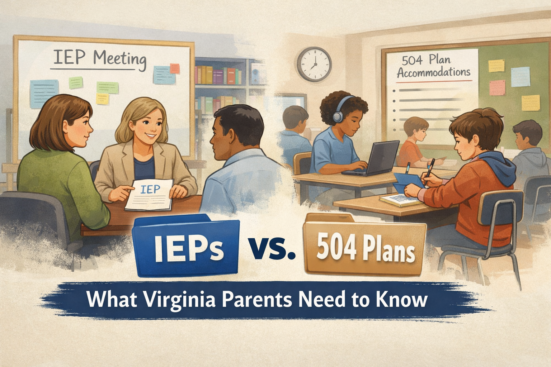
When a child is struggling in school due to a disability, learning challenge, or medical condition, parents often hear two common terms: IEP and 504 Plan. While both are designed to support students, they are not the same. Understanding the differences is essential for Virginia parents who want to ensure their child receives appropriate educational support and legal protections.
This guide explains the key distinctions between IEPs and 504 Plans, including eligibility, legal authority, and the types of services each provides.
What Is an Individualized Education Program (IEP)?
An IEP is a formal, legally binding education plan for students who qualify for special education services.
Legal Basis
IEPs are governed by the Individuals with Disabilities Education Act (IDEA), a federal law that ensures eligible children receive a Free Appropriate Public Education (FAPE) through specialized instruction.
Eligibility
To qualify for an IEP in Virginia, a student must:
- Have one of the disability categories recognized under IDEA (such as specific learning disabilities, autism, emotional disability, ADHD that impacts learning, or speech/language impairment), and
- Require specialized instruction, not just accommodations, to make academic progress.
Eligibility is determined through a formal evaluation conducted by the school system.
What an IEP Provides
An IEP is comprehensive and individualized. It may include:
- Specialized instruction
- Measurable academic and functional goals
- Related services (speech therapy, occupational therapy, counseling)
- Classroom accommodations and modifications
- Progress monitoring and annual reviews
IEPs are developed and reviewed by an IEP team, which includes parents as equal participants.
What Is a 504 Plan?
A 504 Plan provides accommodations to help a student access the general education curriculum but does not include specialized instruction.
Legal Basis
504 Plans are governed by Section 504 of the Rehabilitation Act, a civil rights law that prohibits discrimination based on disability.
Eligibility
A student may qualify for a 504 Plan if they:
- Have a physical or mental impairment that substantially limits one or more major life activities (such as learning, concentrating, or reading),
- But do not require specialized instruction.
This eligibility standard is broader than IDEA, meaning some students who do not qualify for an IEP may still qualify for a 504 Plan.
What a 504 Plan Provides
A 504 Plan typically includes accommodations such as:
- Extended time on tests and assignments
- Preferential seating
- Modified homework expectations
- Access to medication or health supports during the school day
- Behavioral or organizational supports
504 Plans focus on equal access rather than individualized educational programming.
Key Differences Between IEPs and 504 Plans
| Feature | IEP | 504 Plan |
| Governing Law | IDEA | Section 504 |
| Purpose | Specialized instruction + services | Access and accommodations |
| Eligibility Standard | Narrower, disability must affect learning | Broader, substantial limitation |
| Written Plan | Required | Required |
| Parent Participation | Strong procedural rights | Fewer formal protections |
| Enforcement | Due process hearings | Civil rights complaints |
Why the Difference Matters for Virginia Families
Choosing the correct plan affects:
- The level of services your child receives
- Your procedural rights as a parent
- How disputes with the school can be resolved
Virginia schools are required to comply with both IDEA and Section 504, but disputes often arise over eligibility, services, or implementation. Parents may be told a child “only qualifies for a 504” when an IEP may be more appropriate—or that no plan is needed at all.
When Legal Guidance Can Help
If you believe your child:
- Was improperly denied an IEP or 504 Plan,
- Is not receiving the services listed in their plan,
- Is facing discipline related to a disability,
- Or if the school is not responding to your concerns,
consulting an education attorney can help protect your child’s rights and ensure the school meets its legal obligations.
At the Tuomey Law Firm, we assist Virginia families with special education advocacy, IEP and 504 disputes, and school-related legal matters. Our goal is to help parents secure the educational support their children need to succeed.