

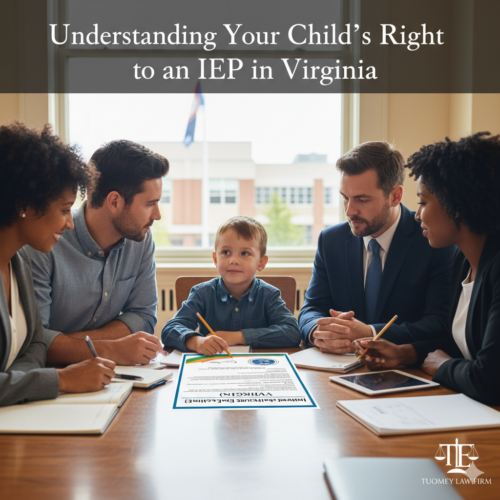
Every child deserves the opportunity to receive a quality education, but for students with disabilities, that often requires additional support. In Virginia, parents and students have specific rights under federal and state law to ensure those supports are provided. The cornerstone of these protections is the Individualized Education Program (IEP).
This guide explains what an IEP is, your rights as a parent, and how to request and secure one for your child.
What Is an IEP?
An Individualized Education Program (IEP) is a legally binding plan developed for students with disabilities who qualify for special education services. It outlines:
- Your child’s present levels of performance
- Specific educational goals
- The services and accommodations the school will provide
- How progress will be measured
An IEP is not a “one-size-fits-all” plan. It is tailored to meet your child’s unique educational needs and must be reviewed and updated at least once a year.
Parent and Student Rights
Virginia parents and students are protected by both the Individuals with Disabilities Education Act (IDEA) and Virginia’s special education regulations. Key rights include:
- Right to Request an Evaluation – Parents may formally request an evaluation if they suspect their child has a disability affecting learning.
- Right to Participate – Parents are equal members of the IEP team and must be involved in every decision.
- Right to Written Notice – Schools must provide prior written notice before changing (or refusing to change) your child’s identification, placement, or services.
- Right to Dispute Resolution – If you disagree with the school’s decisions, you can request mediation, file a complaint, or pursue a due process hearing.
- Right to Confidentiality – Your child’s educational records must be kept private and only shared with authorized individuals.
The Process for Requesting an IEP
- Request an Evaluation in Writing
Parents should submit a written request to the school principal or special education director asking for an evaluation. - School’s Response
The school must respond within a specific timeframe (typically 65 business days in Virginia) to complete the evaluation process. - Evaluation and Eligibility
A team of professionals will assess whether your child qualifies for special education under one of the disability categories outlined by IDEA. - Developing the IEP
If eligible, the IEP team (which includes parents, teachers, specialists, and administrators) will meet to create the IEP document. - Implementation
The school must provide the services and accommodations detailed in the IEP. - Review and Updates
The IEP must be reviewed annually, but parents can request a meeting at any time if concerns arise.
Why Legal Guidance Matters
While schools often strive to meet student needs, disagreements can arise about eligibility, services, or placement. Parents should know they have the right to seek legal guidance. An experienced special education attorney can:
- Review IEP documents for compliance
- Advocate for stronger services and supports
- Represent parents in disputes with the school district
At Tuomey Law Firm, we are committed to helping families navigate the IEP process with confidence, ensuring that children receive the education and support they are legally entitled to.
Final Thoughts
Navigating the special education system in Virginia can feel overwhelming, but knowing your rights—and your child’s rights—makes all the difference. If you believe your child may need an IEP, act quickly, put your requests in writing, and be an active participant in every step of the process.
Your child’s future is worth the effort, and you don’t have to go through it alone.